Elite Sprinkler Repair & Installation
- 628 Tara Dr, DeSoto, TX 75115
★★★★★ 4.9 · 223 Google reviews · TCEQ Licensed

Elite Sprinkler Repair & Installation -
TCEQ Certified
LI0029325
Contact Details -
Contact Details -
Home›Sprinkler Repair›Lancaster, TX
Sprinkler Repair Contractor in Lancaster, TX
Elite Sprinkler Repair & Installation keeps Lancaster lawns watered — repairing and installing irrigation systems across 75134 and 75146 from our shop a few minutes west in DeSoto. Bring us a dead zone, a geysering head, a cracked line, a controller that won’t hold a schedule, or a backflow that failed its test, and we’ll have most of it fixed the same visit. We usually reach Lancaster addresses same-day or next-day, sooner for a line that’s actively running. We’re TCEQ-licensed (LI0029325) with 30+ years on Best Southwest clay.
Fast Response
same-day service
Upfront Pricing
No Hidden Cost
Local & Reliable
Proudly Serving Desoto
TCEQ Certified
LI0029325
We Service All Brands
of Sprinkler Parts


Why Lancaster Homeowners Choose Us
The reason people in Lancaster call us back is boring but rare: the repair holds through the next dry summer. Most failures out here aren’t really parts failures — they’re Houston Black clay dragging a line apart as it swells and shrinks. A handyman glues the crack and moves on, and it splits again by August. We re-bed the run and add flex where the clay works hardest, so you’re not paying to reopen the same trench next year.
Thirty-plus years on Best Southwest soil mostly means we’ve already made every mistake this clay can cause and stopped making them. We know the town-square systems hide corroded splices and undersized wire, and we know the Pleasant Run and Bear Creek builds tend to fail at heads that shifted once the pad settled — so we go straight at the likely cause instead of charging you to hunt for it.
Two things keep it honest. We’re TCEQ-licensed (LI0029325), which in Lancaster isn’t a formality — the city administers backflow prevention and the annual test must be signed by a licensed tester, and unlicensed help can’t legally close that loop. We’re a few minutes west in DeSoto, we carry Rain Bird, Hunter, Toro, and Weathermatic parts on the truck, and we leave your controller set to Lancaster’s twice-weekly schedule so a fixed system never turns into a water-waste surcharge
- Locally-Owned
- Licensed & Trusted
- 5 Stars Rated
30+
Years of Experience
Does Lancaster Require a Licensed Irrigator?
How a Lancaster Repair Goes, Start to Finish
You call or text.
Give us the symptom and your nearest cross streets. Most Lancaster jobs go on the schedule same-day or next-day; a line that's actively running jumps the line. (Under 5 minutes.)
We diagnose on site.
We run each zone, find the failed head, valve, wire, or buried break, and walk you to it so you can see the problem before we touch a thing. (20–40 minutes.)
You get one flat price.
The full repair number comes first — no clock, no hourly meter — and nothing starts until you approve it.
We make the repair.
Heads, valves, controllers, sensors, and backflow work usually wrap the same visit; a dig through set-up Blackland clay can run longer, and we'll tell you that up front. (30 minutes–2 hours.)
We test and hand it back.
We cycle every zone with you, check head-to-head coverage, confirm the rain-freeze sensor fires, and set the controller to a compliant Lancaster twice-weekly schedule before we pull out of the driveway.


Customer Satisfaction Rate
Why the Same Stretch of Line Keeps Splitting in Lancaster
If a Lancaster repair cracks again a year later, the pipe isn’t the problem — the ground is. Lancaster sits on Houston Black clay, the Texas state soil and a textbook vertisol, and it doesn’t sit still. Through a dry summer it pulls open into fissures up to 4 inches wide and roughly 6 feet deep that can stay cracked for months; after a soaking rain it swells shut.
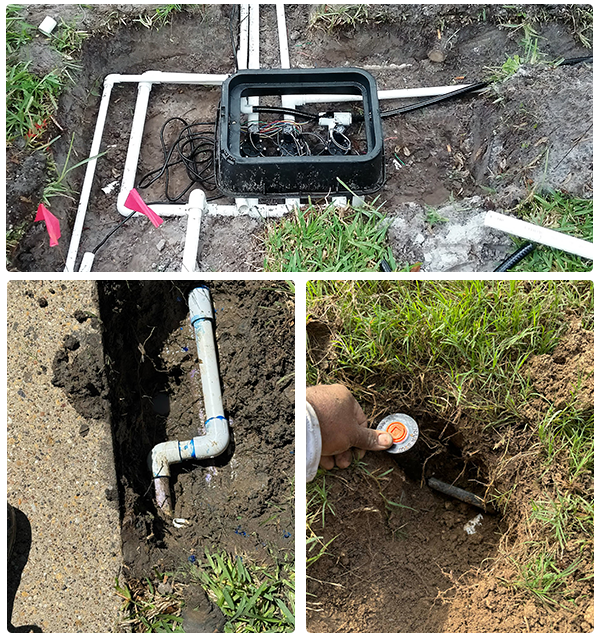
That seasonal heave grips rigid PVC and works it against every fitting and tee until something lets go — almost always at the same rigid point as before. So a glued patch on a moving line is a temporary fix by design. What lasts is re-bedding the run and adding flex at the joints where the clay pulls hardest, which is how we finish a Lancaster repair.
The failure pattern also splits by neighborhood, which is worth knowing before you diagnose your own system. Lancaster was settled in 1852, so systems around the historic town square are long-lived retrofits carrying brittle poly and corroded wire splices from a couple of decades of patches. The fast-growing subdivisions off Pleasant Run and Bear Creek are the opposite — newer builder-grade systems whose heads and valves drift out of alignment as fresh construction pads settle on that same restless clay.
We serviceHunterRain BirdToroWeathermatic
Why Lancaster sprinklers break
Clay soil, Texas heat and hard freezes all take a toll on irrigation systems. We fix the root cause, not just the symptom.
Shifting clay soil
North Texas clay expands and contracts, cracking PVC lines and tilting sprinkler heads.
Relentless summer heat
Heat stress exposes weak zones, clogged nozzles and pressure problems fast.
Hard freezes
Above-ground backflow assemblies can split when the water inside them freezes.
Watering limits
City watering rules mean every zone has to water evenly and efficiently.
Your Questions, our Answers
Frequently Asked Questions
Which sprinkler repairs can I safely do myself?
Why does my line keep cracking in the exact same place?
My water bill jumped but there's no puddle — is it the irrigation?
There's water shooting up right now — how fast can you get to Lancaster?
Do you work on Rain Bird and Hunter systems?
How do I keep my system from cracking in a hard freeze?
Certified, Local, and Highly Rated
7513475146